Simply-Typed Lambda Calculus (STLC)
现在我们需要给lambda calculus加上类型,这样,诸如(λx.x x)(λx.x x)的term在Simply-Typed Lambda Calculus(STLC)中就是非法的。
Why types?
- Type checking catches “simple” mistakes early
- (Type safety) Well-typed programs will not go wrong
- Typed programs are easier to analyze and optimize
当然,Type也会带来缺点,即有些合法的term会被判定不符合type。
(Types):τ,σ::=T ∣ fun
其中T为base type,比如int,bool;fun为function type。
Typing Judgment(给term赋types):
⊢M:τ
Typing Rules:
⊢(λx.M):fun
⊢MN:T⊢M:fun⊢N:T
上面的两条规则还不能保证type safe,如((λf.f 1)3)推导的type是int,但这明显是不符合正常语义的。
因此,我们需要对function的定义进行修改:加上argument type的检查。
因此,我们对前节的定义修改为:
(Types)(Terms):τ,σ::=T ∣ σ→τ:M,N::=x ∣ λx:τ. M ∣ M N
其中Types满足右结合:τ→τ→τ=τ→(τ→τ)
相应的Reduction Rule也要修改为新的Term形式(即对lambda 的参数加上Type):λx:τ.M
Typing Judgement and Context
我们对function中含有的free variable进行定义:将free variable的type作为整体判断的context,如type(f 1)取决于f的type。
因此,Typing judgement实际上是从type of free variable出发,得到完整type的推导过程:
Γ⊢M:τ
因此,我们对Typing Context定义如下:
Γ::=⋅ ∣ Γ, x:τ
点代表空context。
通过Γ,便可以推导出well-typed term的type。
Typing Rules
Γ,x:τ⊢x:τ(var)
Γ⊢M N:τΓ⊢M:σ→τΓ⊢N:σ(app)
Γ⊢(λx:σ. M):σ→τΓ,x:σ⊢M:τ(abs)
Soundness and Completeness
Soundness表示type system 不会接受出错的program(即type-safe),满足no false negatives。
Completeness表示一个program不会拒绝不可能出错的program,满足no false positives。
对图灵完备的语言来说,Type system是做不到同时满足两者的。因此,实践中我们选择满足soundness,并尽可能地减少false positives。
对Soundness(即Type-Safety),有以下定理:
For any M,M′ and τ, if ⋅⊢M:τ and M→∗M′, then ⋅⊢M′:τ, and either M′∈Values or ∃M′′. M′→M′′
其中:(Values)::=λx:τ.M
即well-typed term的reduction要么发散,要么在对应的Value of the expected type上结束。
从中可以有两个推论:
Perservation(subject reduction): well-typed terms reduce only to well-typed terms of the same type.
Progress: a well-typed term is either a value or can be reduced.
另外,well-typed term in STLC是一定会终止的,所以诸如(λx.x x)(λx.x x)的式子就无法得出type。
Adding stuff
STLC的理论已经讲完了,接下来的部分都是扩展内容。
基础的STLC较为简单,但我们可以对其他方面不断扩展,比如:
- 语法(即增加新的type/terms)
- 操作语义(即增加reduction rules)
- Type system(即增加typing rules)
- soundness proof(即new proof cases)
Product Type
(Types)(Terms): … ∣ σ×τ: … ∣ <M,N> ∣ proj1M ∣ proj2M
用C类比的话,即structure的字段存取。
增加的Reduction rules/typing rules比较多,我就贴图了。
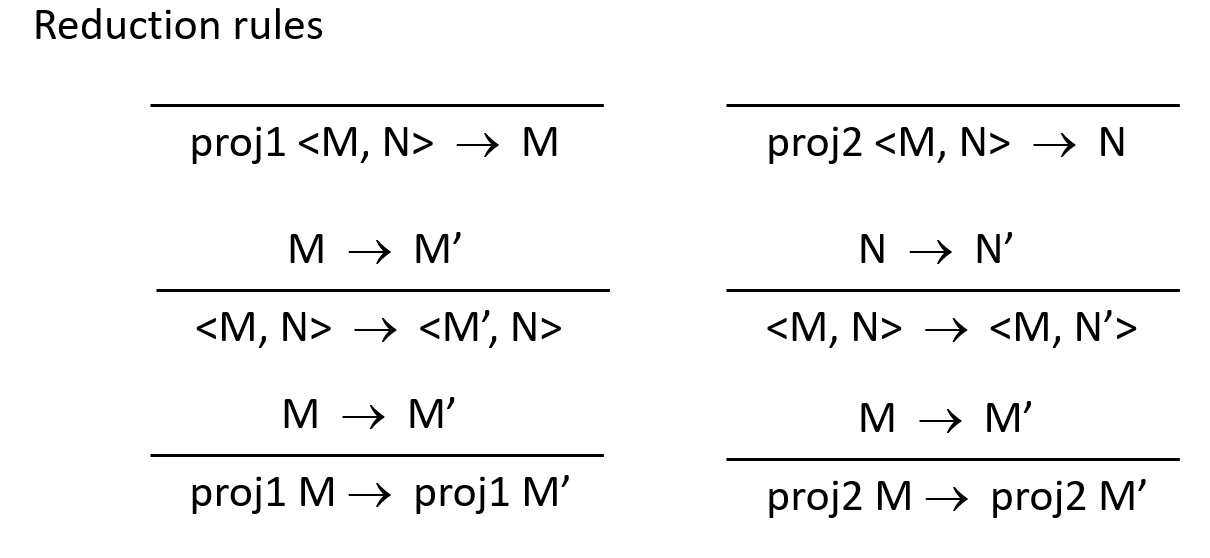
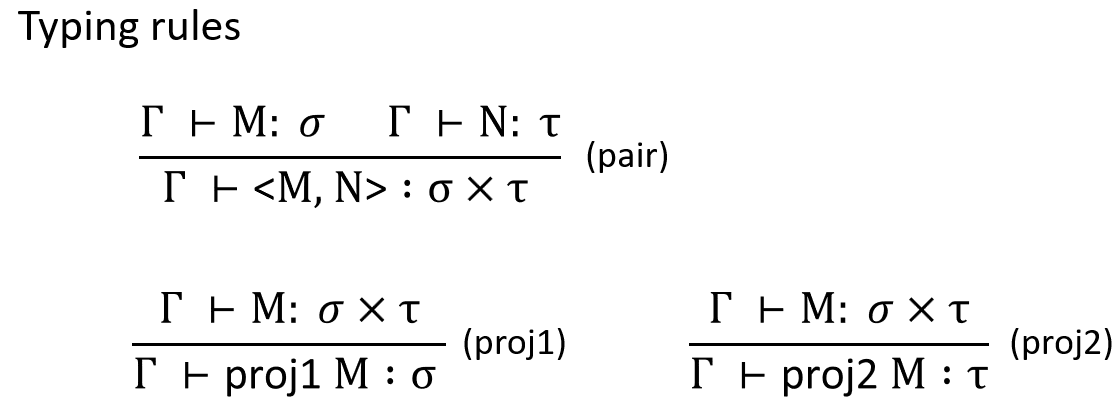
同时,也要对Progress进行修改,即Values增加<v1,v2>。
Sum Type
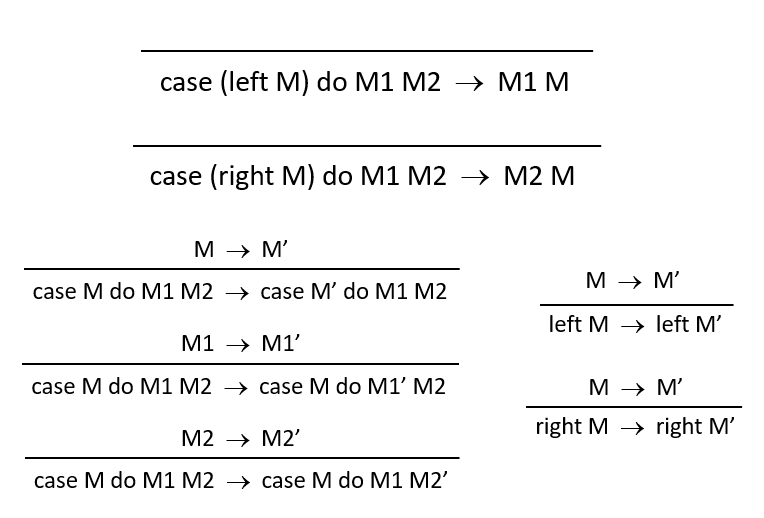
(Types)(Terms): … ∣ σ+τ: … ∣ left M ∣ right M ∣ case M do M1 M2
类比C,就是union。
reduction rules:
typing rules:
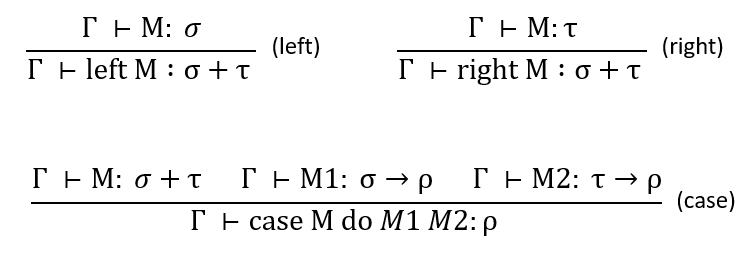
相应的,Progress中的Value也要增加left v & right v.
对比Product和Sum,可以看到Product(σ×τ)是可以接受σ/τ/both的,但Sum(σ+τ)只能选择其中一个。
Recursion
在之前的untyped λ-calculus中,每个term都有自己的不动点fixpoint,由此我们也定义了一系列的fixpoint combinator。但在STLC中,由于well-typed terms最终都要终止,我们无法给这些fixpoint combinator找到对应的类型。
因此,我们修改定义:
(Types)(Terms): … ∣ fix M: … (no new types)
Reduction rules:
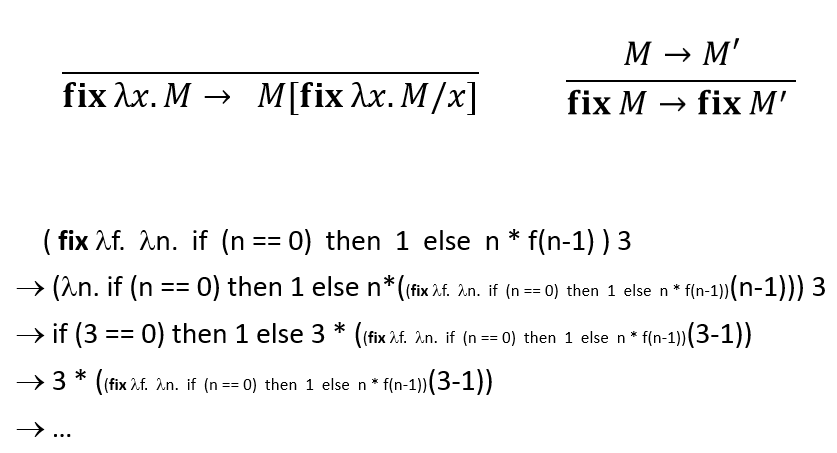
typing rules:
Γ⊢fix M:τΓ⊢M:τ→τ(fix)
怎么理解呢?
- 数学意义上:如果M是τ→τ的函数,那么M的不动点fix M则需要作为M的参数,因此类型为τ.
- 操作语义(reduction)上:第一个规则的替换意味着x和fix λx.M′需要有相同类型。
Curry-Howard Isomorphism
现在我们定义了STLC这种带type的语言,可以去定义编程语言以及类型系统。而逻辑学也可以利用这一工具,去定义命题和命题逻辑,即Proposition are Types, Proofs are Programs。
(Types)τ,σ(Prop)p,q::=T ∣ σ→τ ∣ σ×τ ∣ σ+τ::=B ∣ p⇒q ∣ p∧q ∣ p∨q
以上一一对应。可以看到STLC没有取反操作,这一点我们后面讨论。
Empty and nonempty types
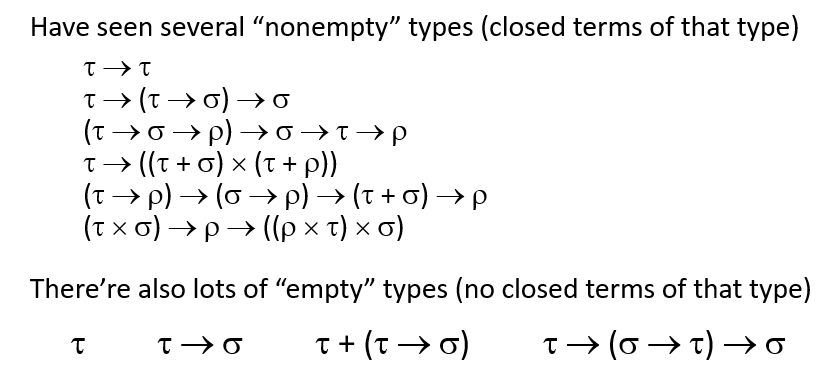
怎么知道一个类型是空的呢?
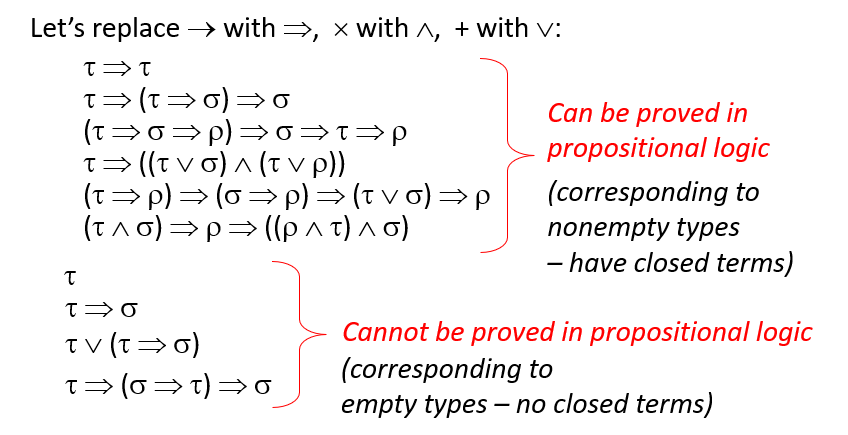
回顾命题逻辑:
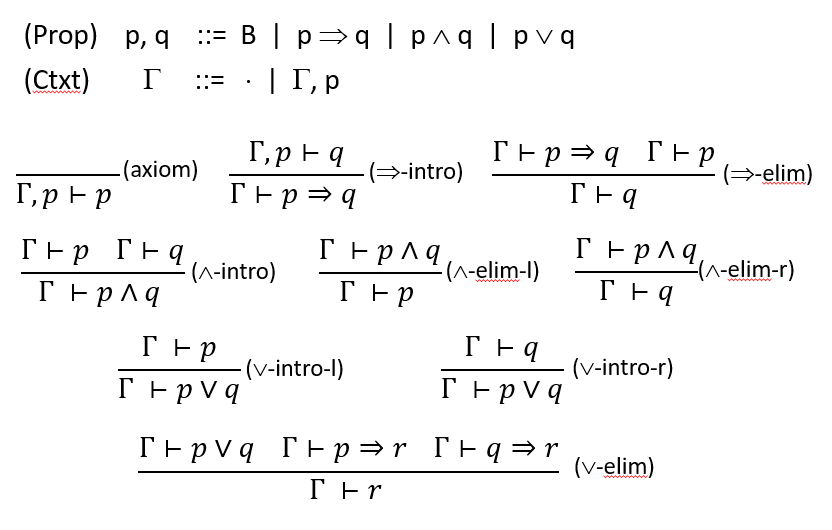
实际上是可以和STLC的类型系统一一对应的。
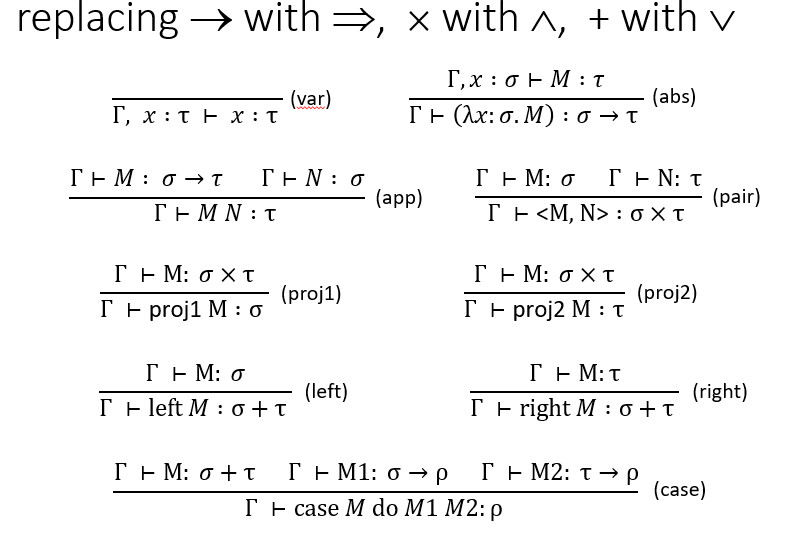 .
.
Curry-Howard isomorphism
因此,我们便得到了STLC和命题逻辑的同构性。
- 对一个well-typed closed term,在 typing derivation 上 erase 这些 terms,最终得到一个 propositional-logic proof。
- 对一个propositional-logic proof,总会存在一个closed term with that type。
- 对term进行类型检查的过程就是一个proof的过程,其表明一个logic formula如何推导到对应的类型。
那么为什么要关注这两者的同构呢?
- 首先当然是很有趣(
- logic和computing通过这种方式统一
- 类型系统不是简单的规则堆积
- 可以用其构造自动证明系统
然而,正如上文提到的,STLC实际上几乎满足了命题逻辑。经典的证明逻辑需要满足排中律,即:
Γ⊢p∨(p⇒q)
但STLC由于没有取反,所以不满足这个定理。因此,从STLC导出的logic只能通过直接证据来进行推导。
因此,若要在STLC中引入排中律,只能显性引入:
(p∨(p⇒q))∧(p⇒r)∧((p⇒q)⇒r)→r
Fix
STLC的 fix 意味着不终止的reduction。而在命题逻辑中,我们自然不想要不终止的证明。
回到 fix 的reduction rule:
Γ⊢fix M:τΓ⊢M:τ→τ(fix)
如果引入了fix,那么我们总是可以将诸如τ→τ的non-closed 类型reduce到τ的closed类型。这自然是不符合命题逻辑的,因此fix需要被命题逻辑排除。
不仅仅是上文的构造性命题逻辑和STLC,实际上每个logic都可以对应上特定的类型系统,但这超出了讨论范围,略过不表。